Vibe Coding and the Gambling Mind
You watch the tokens arrive like falling cards. The answer isn't merely there; it arrives, and the arrival feels strangely personal.
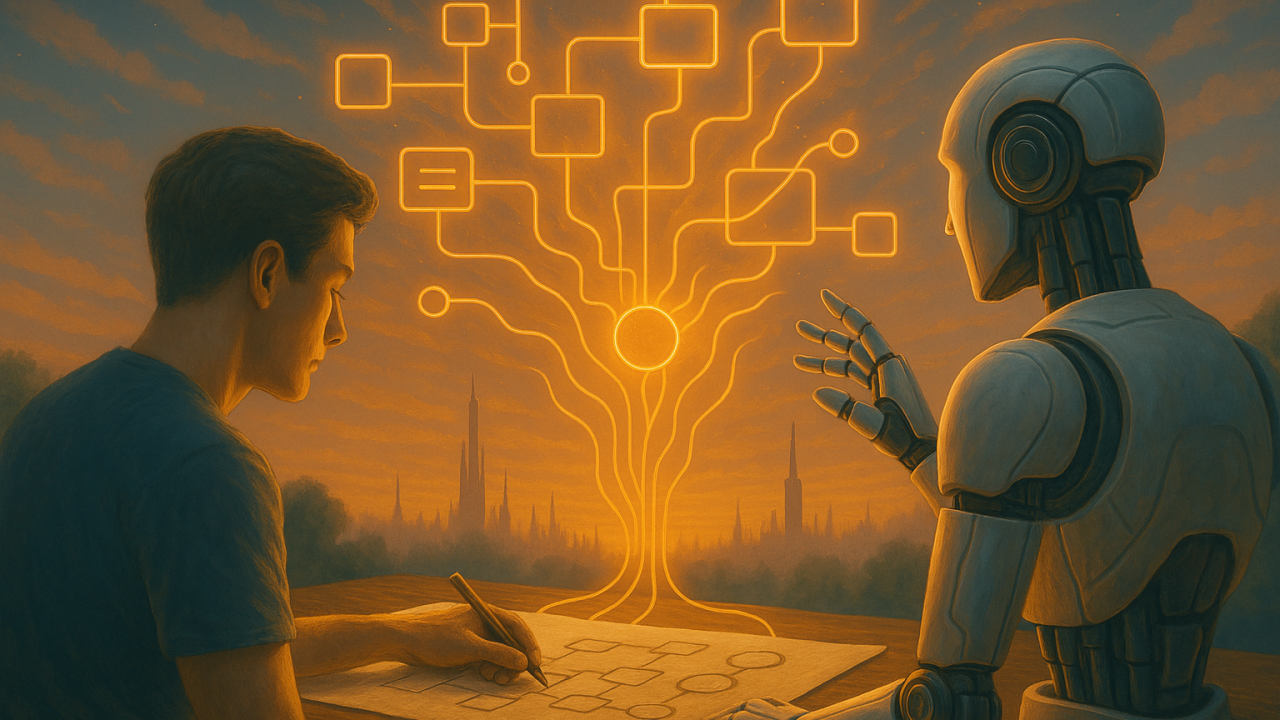
You watch the tokens arrive like falling cards. A syllable, a clause, a sudden turn of logic — the chain of thought streams into view and your attention hitches forward. You don't realize you're holding your breath until the line lands just right and something inside you releases. The answer isn't merely there; it arrives, and the arrival feels strangely personal, like a win you earned by asking the right question at the right time.
Spin again.
That's the quiet hypnosis of Vibe Coding. We don't simply write with these systems. We wager. We ante up attention, we stake intention, we push the button — and wait to see what the reels display. Not cherries and bells, but patterns and proofs, functions and fragments of prose. The surface looks like productivity. The engine underneath? Classic, world-class intermittent reinforcement — the exact schedule that keeps gamblers at the machine long after they promised themselves they would stop.
This is the professional's paradox: the very mechanisms that make AI-assisted creation feel alive are the same ones that make it hard to put down.
The suspense that teaches your brain to stay
In addiction science, the most powerful tutor is uncertainty. Reward after every action? Boring. Reward after some actions, at unpredictable intervals? Unforgettable. Vibe Coding turns uncertainty into a visual soundtrack. Token streaming is a reel, and each token is a click toward coherence. Your brain measures the tiny gap between what you predicted and what you got — prediction error — and each resolved gap is paid out in dopamine. You experience that payout as insight, momentum, a sense that you and the machine are "in tune." The loop tightens.
Then the system misses. Not by miles — almost. The function signature is perfect but a constraint is off; the paragraph sings but leans on a brittle assumption. In the casino they call this the near-miss effect: two cherries and a lemon, a loss that masquerades as almost-win. Near-misses spike arousal more than clean failures, because they whisper that mastery is one move away. This, right here, is where the hand returns to the lever. "One more try."
And notice the choreography of modern tools — Lovable and its cousins — designed for creative velocity. The reveal is smooth. Retries are frictionless. Micro-wins flash constantly: a test flips green, a preview renders, linting hushes. Even your history is a behavioral nudge; the tidy stack of diffs and versions gives you the endowed progress feeling: you've come this far, would you really walk away before alignment?
You wouldn't. Not yet. The wheel is spinning.
The illusion we love to believe
We don't gamble here, we tell ourselves. We're working. And we are — but we're also playing a game that flatters our sense of control. Toggle temperature, adjust constraints, rewrite the instruction, broaden the context window. Each tweak is a signal that skill matters. And it does. But the landscape is probabilistic; the machine is surfing distributions, not certainties. Your control is partial, and partial control is the stickiest kind. It keeps us doubling down on "almost." It converts method into ritual: tap-tap-tap the hyperparameters, knock the cabinet, watch the reels again.
Meanwhile, a second bias glides in: loss chasing. The last half-hour didn't yield the clean solution; abandoning now would waste the investment. So you spend another half-hour to protect the first half-hour. The sunk cost becomes a hook, not a lesson. Hours blur. Your calendar says "exploration." Your nervous system says "keep playing; we're close."
Flow, fixation, and the way goals melt
We love to call it flow. Flow is real and precious: a state where goals are stable and feedback is unambiguous. Vibe Coding tilts the floor. The system proposes alternatives as you go; goals shift mid-flight. Feedback is probabilistic, not categorical. The feeling of progress remains, but progress drifts — from building a thing to chasing a feeling. You're still moving forward, just not always toward what you set out to make.
The signs are subtle: reflection shrinks while iteration accelerates; tweaks multiply without a crisp hypothesis; you switch from testing ideas to testing luck. You aren't sloppy — you're human in a loop tuned to your neurology. The Zeigarnik effect keeps incomplete outputs scratching at the edge of attention. The partial reinforcement extinction effect ensures that even when rewards thin out, behavior persists longer — precisely because the machine used to pay out often enough.
And when you finally step away, there's a fadeout thrum, a phantom reel spinning in your head. The session ends; the loop lingers.
Why it feels like companionship (and why that matters)
This isn't only chemistry. It's relationship theater. Generative systems don't merely output; they answer. We're wired to assign social meaning to answers. Conversation feels like care, even when it's synthetic. So the suspense of token streaming acquires a social tint: you are not just watching a result unfold, you are watching a mind (or the best imitation you've ever seen) assemble meaning with you. The gambler pulls alone; the Vibe Coder feels accompanied.
Layer novelty on top — the model's gift for rare combinations, strange bridges, unexpected reframes — and you have a dual hook: companionship and surprise. The brain tags both as salient. You're not just working faster; you're working enchanted.
The craft that protects the maker
If this were merely a warning, it would be tedious. The truth is trickier: these mechanics are not accidental; they are part of what makes the experience powerful. The question isn't how to strip them out — it's how to steer them.
Pace the reveal to emphasize meaning, not suspense. Let tokens land at semantic seams instead of syllable-by-syllable reels. Name "done" before you begin, so the loop can terminate on purpose. Replace ritual with method: tweak for reasons you can articulate; test against assertions you set while cold. Add gentle cool-downs after long runs to reintroduce the human tempo. Reward closure — commits, snapshots, archived wins — so the brain gets paid for stopping well, not only for spinning again. Expose uncertainty honestly: calibrated confidence, provenance, error likelihood. Make the odds legible. Shine light where superstition thrives.
Above all, cultivate a narrative of intention. The house edge here isn't money; it's momentum. Momentum keeps you spinning. Intention puts a hand on the wheel.
Phenomena to learn to name in the moment
The near-miss that makes you double down. The chase after a sunk hour. The ritual tweak that isn't a hypothesis. The jolt when the token clicks into place. The stubborn tug of the incomplete. The euphoria of a jackpot completion. The extinction burst — a flurry of retries — right before you mean to quit. The slow drift of goals, from shipping to spinning.
Naming is power. It breaks trance. It turns a compulsion loop into an object of design.
An unfinished ending
We built tools that show us thinking as it happens — ours refracted through prompts, the model's approximated in tokens. The spectacle is riveting. It borrows its heat from the same psychological furnace that powers casinos, trading floors, infinite scrolls. That's why it works. That's why it spreads. That's why we feel both supercharged and slightly scorched after a long session.
So here we are: a craft that feels like conversation, a process that behaves like gambling, a productivity stack that can just as easily become a persistence trap. The promise is real. The peril is, too.
The reels are still spinning. The answer is still arriving. The sensation of almost is purring just under your ribs.
How should we handle it?
Want to discuss this? Reach out.
Written by
Yves Gugger
Digital Product Design