Beyond Product – Designing AI Ecosystems
In a world shaped by intelligent systems, the idea of 'a product' is starting to feel small. Not because it's irrelevant. But because it's incomplete.
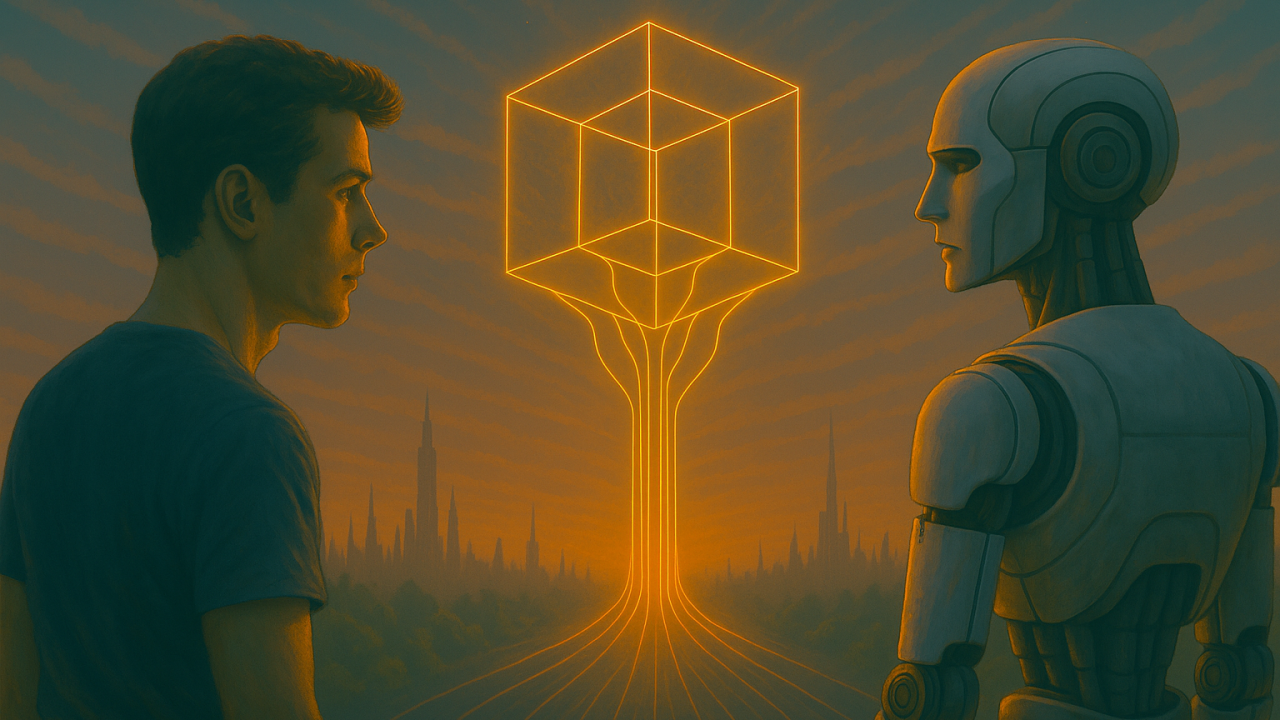
In a world shaped by intelligent systems, the idea of "a product" is starting to feel… small.
Not because it's irrelevant. But because it's incomplete.
We've spent decades perfecting the art of building discrete digital products: Apps with clean interfaces. Services with sharp value propositions. Journeys optimized to convert, retain, delight.
But AI doesn't live in silos. It flows. It connects. It learns across boundaries.
And so must we.
From Objects to Ecosystems
AI changes the design canvas.
It's no longer just about building one interface or touchpoint. It's about shaping systems of interaction:
- A model trained on one app can improve another.
- An API exposed in one service becomes the brain of another.
- Agents learn through context, not confinement.
In this new reality, products are no longer standalone things. They're nodes in an AI-powered ecosystem.
And ecosystems behave differently:
- They evolve through feedback, not feature roadmaps.
- They grow by interoperability, not isolated polish.
- They succeed through orchestration, not control.
Agents, APIs, and Emergent Intelligence
AI systems don't just extend products. They mediate between them.
Think about:
- Language models as universal translators between user intent and system action
- Autonomous agents orchestrating multiple services on your behalf
- APIs that don't just return data, but interpret and decide
In this world, the role of design moves from crafting interfaces to enabling interactions between systems.
It's not about a beautiful app. It's about trustworthy, transparent orchestration.
What we design is no longer the thing itself. It's the behavior between things.
Designing for Emergence
When intelligent systems connect, new behaviors emerge:
- A model trained on customer support starts helping sales.
- A recommender system influences supply chains.
- A personal assistant rewrites how we calendar, email, and book.
These emergent patterns are powerful. But they're also unpredictable.
Which means designers must learn to think like ecosystem stewards, not just product owners.
Ask:
- What happens when two intelligent agents talk to each other?
- Who owns the outcome when systems combine?
- What values, ethics, and boundaries persist across services?
Designing for AI ecosystems is not about certainty. It's about resilience, interoperability, and intentional emergence.
Feedback Is the Interface
In AI ecosystems, feedback becomes the core design surface.
Every user interaction becomes a data point. Every service touchpoint becomes a learning opportunity.
So we must ask:
- How do we design feedback loops across systems?
- How do we surface learning, adaptation, and failure?
- How do we give users agency within an ecosystem that learns?
This means going beyond UI affordances. It means designing system transparency, controllability, and narratives of learning.
We must show not just what a system does – but why, how, and on whose behalf.
Ecosystem Thinking = New Design Literacy
To design AI ecosystems, we need a new creative vocabulary.
- From wireframes → to protocols
- From flows → to feedback architectures
- From journeys → to interactions between actors (human & non-human)
- From delight → to trust, governance, and intent alignment
This doesn't mean we abandon UI. It means UI becomes one of many system surfaces.
And designers become architects of possibility spaces, where agents, APIs, and humans shape outcomes together.
The End of the "Product" Mindset
What we once called a product is dissolving into platforms. What we once saw as services are becoming intelligent nodes. And what we used to design as linear experiences are now dynamic collaborations between models and people.
This is not science fiction. It's happening now.
Think:
- Open agent frameworks like AutoGPT or Cognos
- Interoperable APIs between learning services
- Context-aware assistants stitching together Slack, Notion, and your OS
The future of design is not just a better app. It's a more meaningful ecosystem.
One where intelligence is ambient. Where services negotiate, adapt, and assist. And where human intent is the true interface.
So What Does This Mean for Designers?
It means our role expands.
We're no longer just creating features. We're creating conditions for intelligence to thrive, responsibly.
That requires:
- Systems thinking
- Ethical imagination
- Strategic alignment with tech and data teams
- A deep commitment to transparency and user agency
It's harder. It's messier. And it's far more important.
Because when ecosystems shape behavior, design becomes infrastructure.
And those who design it — shape the future we live in.
Want to discuss this? Reach out.
Written by
Yves Gugger
Digital Product Design